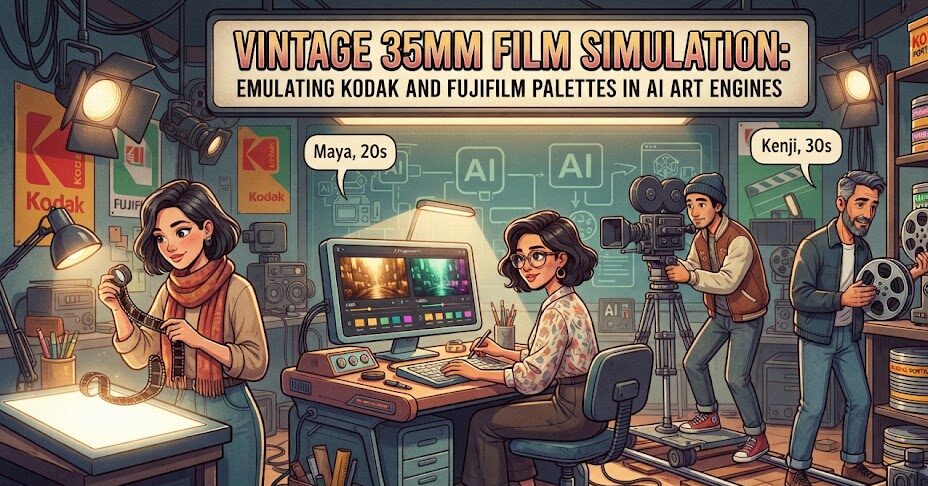
Vintage 35mm Film Simulation: Emulating Kodak and Fujifilm Palettes in AI Art Engines
In an era dominated by hyper-polished digital sensors, razor-sharp smartphone algorithms, and pristine AI renders, the tactile imperfection of analog 35mm chemical film has experienced a massive resurgence. The subtle organic grain, delicate red-orange highlight halation, gentle highlight roll-off, and distinct spectral color profiles of traditional film stocks evoke nostalgia, intimacy, and narrative weight that digital photography simply cannot replicate.
However, simply adding the generic words “vintage look” or “film grain” to an AI prompt usually yields terrible results: excessive digital noise, murky brown washes, or washed-out sepia tones that look like cheap Instagram filters. To accurately simulate authentic film stock in engines like Midjourney v6, Flux.1, and Stable Diffusion XL, creators must understand the chemical color science of iconic photographic emulsions. In this comprehensive guide, we dissect the color DNA of legendary Kodak and Fujifilm stocks, present five complete palette token systems with exact HEX references, detail optical aberration parameters, and provide copy-paste prompt seeds for true analog realism.
1. The Chemistry of Emulsion: Why Analog Color Differs from Digital Sensors
Digital camera sensors capture light linearly across silicon photodiodes, translating photons into rigid mathematical numbers. Chemical film, by contrast, relies on light-sensitive silver halide crystals suspended in gelatin layers. This creates several unique optical characteristics that define the “analog film look”:
1. Non-Linear Highlight Roll-Off
When a digital sensor is overexposed, the pixels “clip” instantly to pure, harsh digital white (#FFFFFF). Film emulsion responds gradually: as highlights brighten, chemical crystals saturate smoothly, retaining delicate texture and warm tonal gradation in clouds, direct sunlight, and bright specular reflections.
2. Red Halation and Anti-Halation Layer Glow
Halation is the hallmark of genuine 35mm movie film (such as Kodak Vision3). When intense light penetrates all layers of the film strip, it reflects off the film base back into the red-sensitive bottom emulsion layer. This produces a signature warm, reddish-orange blooming glow around high-contrast light sources, neon lamps, and backlit hair strands.
3. Organic Silver Halide Grain vs Digital Noise
Digital noise is chromatic, jagged, and uniform across rectangular pixels. Film grain is irregular, tactile, and clumps naturally within mid-tones and shadow valleys while leaving smooth highlight areas relatively clean. Prompting for authentic grain requires referencing physical emulsion chemistry rather than digital post-processing artifacts.
2. Legendary Film Stocks and Their Chromatic Signatures
Each historic film manufacturer formulated distinct dye-couplers and emulsion chemistry, creating recognizable color characteristics:
Iconic Analog Film Stocks Comparison
| Film Stock Name | Color Temperature Bias | Primary Chromatic Strength | Best Narrative Use Case |
|---|---|---|---|
| Kodak Portra 400 | Warm (approx. 5200K) | Golden skin tones, pastel warmth, soft contrast | Editorial portraits, fashion, lifestyle daylight |
| Kodak Vision3 500T | Tungsten Balanced (3200K) | Deep teal shadows, orange key light, strong halation | Cinematic night scenes, gritty street narrative |
| Fujifilm Superia 400 | Cool / Neutral | Emerald greens, magenta shadow undertones | Documentary, candid street, overcast foliage |
| Fujifilm Velvia 50 | High Saturation | Deep cobalt blues, punchy sunset reds, crisp blacks | Landscape photography, bold graphic travel art |
| Kodak Tri-X 400 | Monochrome | High dynamic contrast, deep charcoal blacks, rich grain | Photojournalism, street photography, moody portraits |
3. Five Production Palettes with Exact HEX Color Seeds
Below are five production color sets calibrated from scanned physical 35mm film negatives, complete with exact HEX codes for web design tokens and prompt engineering.
Palette 1: Kodak Portra 400 (Warm Sunlit Skin & Golden Haze)
The undisputed favorite of portrait photographers: gentle highlight rolloff, golden skin tones, and soft olive undertones.
| Role | Color Name | HEX Code | RGB Value |
|---|---|---|---|
| Highlight Glow | Soft Bisque Parchment | #FFF1DB | rgb(255, 241, 219) |
| Skin Tone Key | Warm Honey Terracotta | #E8A87C | rgb(232, 168, 124) |
| Midtone Blend | Faded Rose Mauve | #C38D9E | rgb(195, 141, 158) |
| Foliage Accent | Muted Olive Sage | #859688 | rgb(133, 150, 136) |
| Shadow Anchor | Soft Espresso Char | #2D2826 | rgb(45, 40, 38) |
Palette 2: Kodak Vision3 500T (Night Cine Motion Picture)
The standard for Hollywood motion pictures: rich cyan-blue shadow cast, tungsten lamp highlights, and distinct orange rim halation.
| Role | Color Name | HEX Code | RGB Value |
|---|---|---|---|
| Halation Glow | Red-Orange Halation | #FF6B35 | rgb(255, 107, 53) |
| Tungsten Key | Sodium Light Warmth | #F7C59F | rgb(247, 197, 159) |
| Shadow Midtone | Deep Cinema Teal | #004E64 | rgb(0, 78, 100) |
| Atmosphere Fill | Slate Midnight | #1A2634 | rgb(26, 38, 52) |
| D-Max Shadow | Deep Asphalt Obsidian | #0B0E14 | rgb(11, 14, 20) |
Palette 3: Fujifilm Superia 400 (Everyday Nostalgia & Emerald Shadows)
Iconic consumer film aesthetic characterized by cold emerald undertones in mid-tones and magenta hue shifts in deep shadows.
| Role | Color Name | HEX Code | RGB Value |
|---|---|---|---|
| Clean Sky | Overcast Ice White | #E8F1F2 | rgb(232, 241, 242) |
| Botanical Glow | Celadon Mist | #A3C9A8 | rgb(163, 201, 168) |
| Emerald Tone | Deep Pine Green | #4E6E58 | rgb(78, 110, 88) |
| Shadow Shift | Muted Plum Violet | #5B4058 | rgb(91, 64, 88) |
| Base Density | Subdued Forest Coal | #1B1E1C | rgb(27, 30, 28) |
Palette 4: Fujifilm Velvia 50 (Vivid Landscape & Saturated Chrome)
Reversal slide film known for its intense color saturation, dramatic sky blues, and punchy sunset crimson tones.
| Role | Color Name | HEX Code | RGB Value |
|---|---|---|---|
| Vivid Magenta | Solar Flare Rose | #FF0055 | rgb(255, 0, 85) |
| Sunlight Punch | Deep Amber Marigold | #FF9900 | rgb(255, 153, 0) |
| Cyan Sky | Clear Mediterranean Blue | #0077B6 | rgb(0, 119, 182) |
| Deep Marine | Rich Cobalt Navy | #023E8A | rgb(2, 62, 138) |
| Crushed Depth | Abyssal Indigo Shade | #03045E | rgb(3, 4, 94) |
Palette 5: Kodak Tri-X 400 (Classic Silver Halide Monochrome)
The definitive photojournalism stock: punchy midtones, rich silver gradients, and gritty organic grain structure.
| Role | Color Name | HEX Code | RGB Value |
|---|---|---|---|
| Paper Base | Unexposed Silver Chalk | #F4F4F5 | rgb(244, 244, 245) |
| High Midtone | Soft Pewter Gray | #A1A1AA | rgb(161, 161, 170) |
| Low Midtone | Oxidized Graphite | #52525B | rgb(82, 82, 91) |
| Deep Shadow | Dense Zinc Black | #27272A | rgb(39, 39, 42) |
| Absolute D-Max | Pure Silver Nitrate Core | #09090B | rgb(9, 9, 11) |
4. Essential Prompt Keywords: Emulating Optical Camera Aberrations
Chemical film never operates in isolation; it passes through mechanical vintage camera bodies and manual glass lenses. To achieve authentic analog realism in AI engines, combine film stock names with vintage optical characteristics:
Optical and Mechanical AI Prompt Modifiers
| Camera Parameter | Keyword Token to Inject | Visual Result in Output |
|---|---|---|
| Specific Film Stock | shot on Kodak Portra 400, 35mm film photograph | Applies stock-specific color curves and highlights |
| Chemical Halation | red-orange highlight halation around light bulbs | Warm glow around high-contrast illumination sources |
| Lens Artifacts | subtle chromatic aberration at edges, lens flare | Color fringing on high-contrast perimeter borders |
| Optical Bokeh | shot on Leica Summicron 35mm f/2 lens, creamy bokeh | Smooth elliptical background blur and shallow depth |
| Grain Mechanics | authentic silver halide grain structure, uncompressed | Natural, irregular tactile texture across shadows |
5. Production Master Prompt Recipes for Midjourney & Flux
Below are tested prompt formulas engineered for true analog aesthetics across Midjourney v6 and Flux.1.
Recipe 1: Kodak Portra 400 Street Portrait (Midjourney v6)
Recipe 2: Kodak Vision3 500T Cinematic Night Scene (Flux.1)
Recipe 3: Fujifilm Velvia 50 Dramatic Coastal Landscape (Midjourney v6)
6. Negative Prompts: Banishing Digital AI Artifacts
Generative AI engines naturally lean toward high-frequency digital sharpness, artificial HDR smoothing, and over-sharpened plastic skin. Maintain this negative stack to preserve analog authenticity:
7. Final Production Checklist for Analog Emulation
- Name the specific film emulsion (e.g., Kodak Portra 400, Vision3 500T, Velvia 50) rather than generic “retro film.”
- Pair film stocks with vintage lens systems (Leica Summicron, Carl Zeiss, Cooke Cine) to establish authentic focal blur.
- Explicitly command
highlight roll-offandred halationto replicate chemical light physics. - Anchor deep shadows with soft charcoal or warm indigo rather than absolute digital black (#000000).
- Use negative prompt stacks to eliminate artificial HDR and over-smoothed digital artifacts.
By treating 35mm film simulation as a rigorous study in chemical light behavior, dye-layer saturation, and optical glass mechanics, you can craft evocative, tactile AI imagery that resonates with the timeless human quality of classic analog photography.